

How Mortgage Amortization Works
Every fixed-rate mortgage works the same way. Your payment never changes, but what is inside that payment changes every single month. Interest is calculated on your remaining balance, so early on, when the balance is largest, interest claims most of the payment. On a $450,000 loan at 6.25%, the first payment is $2,771, of which $2,344 is interest. Only $427 actually reduces what you owe. About 19 years in, the split finally flips, and from there the balance falls fast. That slow shift is amortization, and the calculator below lays out your entire schedule, month by month.
Every extra dollar you pay goes straight to the principal. A smaller balance means less interest next month, and every month after.
Whether that's a good use of the dollar is the honest question. I often say, "Every dollar you have can be earning or saving something." A dollar can earn a return in stocks, mutual funds, or bonds, or it can save interest, which is itself a return. Saving 6.25% and earning 6.25% put you in the same place at the end of the year; one is guaranteed, and the other is not. When rates started with a 3, the choice was easy: keep the cheap money and invest elsewhere. In the mid-6s, it's legitimately close, and close decisions deserve real numbers instead of rules of thumb.
None of this is a recommendation to prepay your mortgage. It's the full picture of how the math works. Run your numbers, weigh your alternatives, and decide with real figures in front of you.
Run Your Numbers
Enter your loan amount, rate, and term. Then click Pay Down Your Loan Faster and test an extra payment at any frequency. The calculator shows your interest saved, your new payoff date, and a full year-by-year schedule you can download as a PDF.
The Calculator Is One Piece of the Puzzle
How extra payments fit alongside your rate, your timeline, and everything else your money could be doing is a bigger conversation. If you'd like to talk through strategies for saving interest and building wealth over time, I'm happy to walk through your numbers together.
*No sales pressure, just the math.
How Does a Lower Rate Impact Amortization?
When rates drop, the first benefit everyone notices is a lower payment. But here's a bit of simple math worth pausing on. Take an $850,000 home in DC with 10% down, a $765,000 loan. If you save 1% on that loan, you'd expect to save about $7,650 a year. Yet the payment only drops around $500 a month, roughly $6,000 a year.
Where did the money go? It went to paying your loan down faster. It's a little-known fact about how amortization works: at the lower rate, you'd pay about $135 more toward principal within your payment, around $1,600 a year in this example. Your savings are twofold. There's the cash-flow savings you can spend on life every month, and there's amortization, or what I call your Housing 401(k). Real savings, just hard to touch.
The chart below shows how that plays out across the full range of rates.
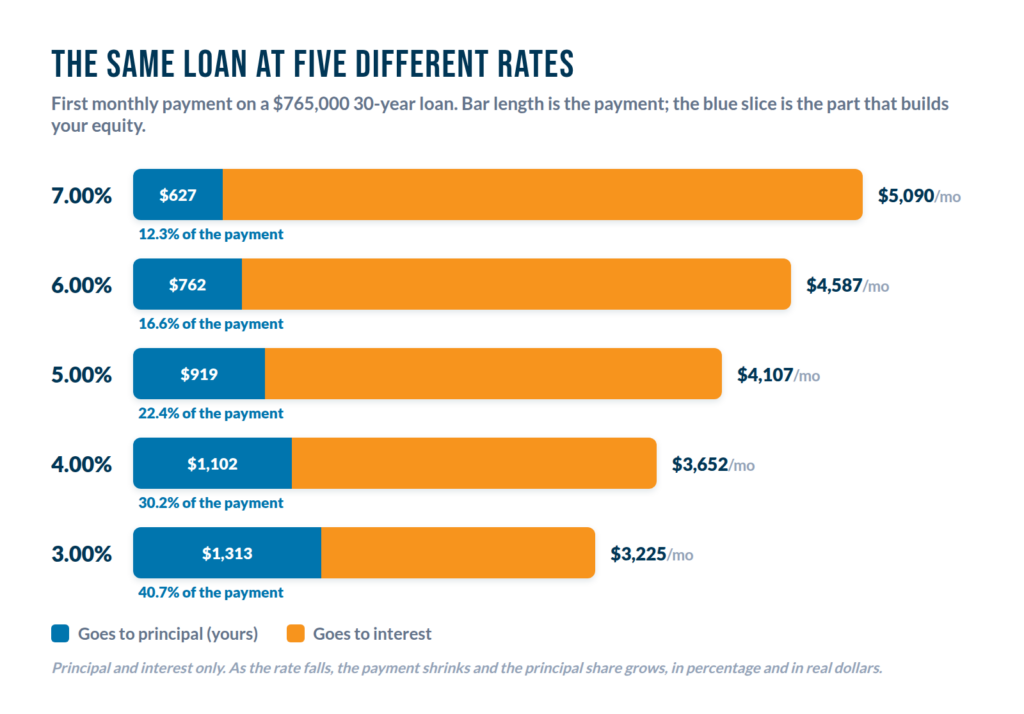
As rates decrease, the percentage of your payment going toward principal increases, and so does the monthly dollar amount, all while your total payment drops. You can see it in the chart: at 7%, only about 12% of that first payment goes toward your balance. At 3%, it's over 40%.
Expert Insight: Look at Both Sides of a Rate
Any time you're comparing two rates, whether it's a refinance or paying points at closing, look at both the cash-flow savings and the change in principal. Most people only ask about the payment. The amortization side is quieter, but it's part of your return on that decision too.
Three Ways to Make One Extra Payment a Year
The most common payoff strategy in mortgage lending is also the simplest: make one extra payment per year. There are three ways people do it, and they all end up in nearly the same place. Let's stick with our $850,000 DC home example, a $765,000 loan at 6.5%.
(Note: All three land in nearly the same place. On this loan, one extra payment per year saves over $200,000 in interest and takes more than five years off the loan. The monthly way is technically a touch better because the money starts working sooner, but the honest advice is to pick whichever one you'll actually stick with.)
Should You Take a Shorter Mortgage Term?
Shorter terms usually come with lower rates. Not always, but most of the time. The savings over the life of the loan can be enormous. On a $765,000 loan, a 20-year term at just a quarter percent below the 30-year rate saves roughly $400,000 in total interest.
So why doesn't everyone take one? Because the tradeoff is real.
The Reward
A lower rate, hundreds of thousands less in interest, and a loan that builds equity fast from the very first payment. It's forced savings into your Housing 401(k).
The Risk
The higher payment isn't optional. It's fixed, every month, for the life of the loan, no matter what happens to your income or your life.
I've had clients take 15-year loans that fit perfectly into their retirement plan. Then a job loss or a life event hit, and that payment became a real challenge. More than once I've heard the same sentence afterward: "I should have taken the 30-year and just paid more each month. At least I would have had the flexibility."
What If the Rates Are the Same?
Sometimes the rate discount for a shorter term disappears, and this happens most often with jumbo loans, those above $832,750. It's not uncommon to see a jumbo 20-year price at the exact same rate as the 30-year.
When that happens, the decision gets much easier. Here's why:
If the rates are the same, a 30-year loan where you make the 20-year payment amortizes exactly like the 20-year loan. Down to the penny. Same payoff date, same total interest. The only difference is that the higher payment is your choice instead of your contract.
So the real question isn't 20 versus 30. It's whether you want flexibility or commitment. If income drops, if life happens, or if a great investment comes along, the 30-year lets you step back to the lower payment that month. And to be fair, some of my clients want the opposite. They choose the shorter term precisely because it forces the savings. Both answers are right. It depends on which one is right for your house.
One more point in the 30-year's favor that most people never hear: the extra dollars you prepay aren't locked away. A recast can later re-amortize everything you've prepaid into a lower required payment, usually for about $250, and my mortgage recast calculator shows what that release valve looks like on your loan.
The Calculator Is One Piece of the Puzzle
How extra payments fit alongside your rate, your timeline, and everything else your money could be doing is a bigger conversation. If you want to talk through strategies for saving interest and building wealth, I'm happy to walk through your numbers together.
Shopping for a rate instead? Request a Quote here →
